Before a single ScanPod™ is installed, before the gardens and cafés are built, before the campus comes alive, the site needs a backbone. At ScanPort™ OKC, that backbone is the Thermal Utility Engine™ — a $250 million clean-energy infrastructure system that powers everything that follows.
This is not a traditional utility plant.
It is a fully integrated, containerized energy architecture built from advanced GreenBox™ Beyond Mil-Spec™ units, geothermal wells, deep thermal corridors, fluid vaults, extreme temperature fluid tanks, high-pressure conduits, micro-generation modules, and intelligent thermal routing pathways. Together, they form the grid-within-a-grid that makes ScanPort™ possible.
And this is where all facility development begins.
Why this equipment comes first
Thermal Utility Engine™ is part of the Phase 1 of ScanPort™.
Everything else depends on it:
• The seven foundational ScanPods require it to operate.
• The perimeter wall system connects into it.
• Every future Pod plugs into it for heat extraction, cooling, micro-power, AI compute stabilization, and energy storage.
• Beyond-net-zero performance is only possible because this system exists underneath the entire campus.
Without this equipment installed, nothing above ground can function.
With it installed, the entire site can begin producing clean energy, stabilizing its thermal flows, and preparing to receive scanning systems used for pediatric diagnostics and long-COVID recovery.
Why this is where private capital enters the project
The equipment that forms the Thermal Utility Engine™ ("TUE") qualifies under U.S. clean-energy (Section 48E) and digital-infrastructure rules as eligible property for accelerated incentives. For that reason, ScanPort™ launches with a $250 million equipment purchase program ("EPP"), available in $1 million indivisible equipment interests, to fund the construction, fabrication, and installation of this infrastructure, ("TUE-EPP")
TUE-EPP is the ground-floor capital that makes the rest of the facility possible:
the geothermal spine, the thermal corridors, the distribution pads, the energy vaults, the micro-generation units, the specialty extreme temperature fluid tanks and the intelligent systems that allow every part of the campus to run.
Your participation in this program is not abstract — it places real equipment into the ground that supports real children and real medical research.
And because of how federal and state incentive structures work, your participation is also eligible for something new: Self-Directed Incentive Capital™, which allows you to redirect tax payments into this infrastructure instead of sending those dollars to Washington.
Recent federal incentive policy has created an unusual opportunity for individuals and family trusts in the highest tax brackets: the ability to determine where a substantial portion of their federal tax payments will be spent.
As a qualifying party, when you acquire one or more $1 million indivisible interest(s) in the Thermal Utility Engine™ Equipment Purchase Program ("EPP"), federal law allows a large share of your annual tax payments to be redirected into the purchase of that equipment—equipment you will own.
Two provisions enable this.
Under Section 168(k), qualifying clean-energy equipment qualifies for 100% bonus depreciation, allowing top-bracket taxpayers to offset up to 40.8% of the purchase price of each $1 million indivisible interest—$408,000— from their federal tax payments to acquire the equiipment.
Then, when the equipment is delivered and placed in service, Section 48E provides an additional 40% investment tax credit per $1 million indivisible interest —another $400,000—which offsets your federal tax payments that would otherwise be remitted to Washington, in essence enabling you to decide how your federal tax dollars are spent.
In total, federal policy allows $808,000 of federal tax revenue to be applied to your $1 million equipment purchase, leaving $192,000 to be covered from personal capital. Put differently: for every $1 you apply, the federal government contributes approximately $4.21, for qualifying participants.
State tax treatment can further amplify this effect.
In California, where the top state income-tax bracket is 13.3%, a participant may receive approximately $133,000 of additional value through accelerated state-level depreciation over the five-year holding period.
For a California resident, that means:
• Your net capital: approximately $59,000
• Federal + state contribution: approximately $941,000
• Ratio: For every $1 you apply, federal and state authorities contribute approximately $15.94
These are not subsidies paid to someone else.
This structure simply allows you to self-direct your federal and (in some states) your state tax payments—payments already owed and already committed—into the creation of advanced clean-energy infrastructure supporting pediatric disease, long-COVID recovery, and next-generation clinical scanning.
SDIC is simple at its core
You place a $1 million unit under contract, make the 10% deposit required by December 29, 2025, and federal and state authorities allow you to satisfy the majority of the remaining purchase price with tax payments you would have made anyway.
The result
You acquire a critical piece of infrastructure—supporting children, families, and long-COVID survivors—while contributing only a fraction of its cost from personal capital.
ScanPort™ is engineered to operate Beyond Net Zero, producing more clean power than it consumes — and directing that surplus toward programs that support children and youth through ScanKids™.
What happens after you acquire your equipment interest?
During the initial Development & Transition Period—the equipment you purchase is installed and operated as part of Phase 1 construction of ScanPort OKC. This phase includes the build-out of the Thermal Utility Engine™, early micro-generation systems, and the first seven ScanPods.
During this period, ordinary costs associated with the equipment—maintenance, insurance, monitoring, and scheduled servicing—are expected to be supported by project revenues and site-level cash flow under the tariff framework. The program is structured so that these operating requirements are anticipated to be met at the project level rather than through participant contributions. This design is intentional and part of the development-phase financial architecture.
Phase 1 is engineered so that the clean-energy equipment you own is financially self-supporting during installation, commissioning, and the early operational ramp. As the site moves from construction into steady-state operation, increasing ScanPod activity and expanding thermal-electric output are expected to provide the financial backbone that supports the equipment during this transitional era.
The result:
For approximately seven years, you hold title to advanced clean-energy equipment essential to pediatric disease research, long-COVID recovery, and community health, while project-level revenues are structured to support the ordinary operating costs during this development and transition period.
The Thermal Utility Engine™ is designed to enter service during a seven-year development and transition period as the broader SCANPORT™ campus comes online.
Throughout these seven years, the SCANPORT™ environment expands—new pods activate, clinical and research programs grow, and the digital-intelligence framework begins learning from real-world thermal, clinical, and operational patterns.
As these systems evolve, they reveal where refinements are valuable: additional sensing, updated controls, improved edge intelligence, and integrations that can only be identified once the full campus is functioning.
This is also the period in which county-level public authorities form under the O|Zone™ Initiative.
Early development is carried out privately to accelerate timelines; as operations stabilize, new governmental entities—including the SCANPORT™ Port Authority and related utility authorities—assume their long-term roles. They adopt the UN-modeled tariff structure, issue tax-exempt municipal bonds for eligible public components, and fully integrate the Thermal Utility Engine™ into the permanent infrastructure of the site.
By the end of the seven-year period, two conditions align: the system is ready for a comprehensive technology refresh, and every indivisible interest in EPP has satisfied its required five-year holding period.
The tariff anticipates this moment. It enables the sponsor to initiate a refresh cycle that modernizes the entire Thermal Utility Engine™ for the next 90 years of operation and provides clean, compliant pathways for participants to exit their original interests without disrupting the regulatory or revenue framework.
At the end of the seven-year development and transition period, the Thermal Utility Engine™ reaches the point at which a system-wide upgrade is scheduled under the tariff. This upgrade integrates new technologies, updated controls, and operational refinements identified during the first years of service.
To enable this transition, each indivisible interest in the equipment follows one of two pathways:
1. Fair-market repurchase by the sponsor, providing a clean economic exit at the then-determined value, which may result in recapture of bonus depreciation; or
2. A charitable gift of the indivisible interest to ScanKids Foundation, a de novo nonprofit formed to support pediatric health, long-COVID recovery, and related community missions, with no bonus depreciation recovery.
Both pathways are designed to comply with the holding requirements that applied at the time the equipment was originally acquired. And both allow the upgrade cycle to move forward without disruption.
The gift pathway, however, unlocks a distinctive benefit:
When the indivisible interest in EPP is transferred to ScanKids, the tariff structure allows equipment owned by the nonprofit to undergo the required recalibration and modernization using project-level revenues earmarked for that purpose.
Because the nonprofit receives not only the EPP equipment but also the long-term tariff operational position associated with it, the value of the gifted interest may be substantially higher than the participant’s original net capital. ScanKids may reflect this value in the gift acknowledgment it provides to the donor, creating a significant charitable deduction with no restrictions on its use.
In effect, the SDIC framework produces a third benefit in addition to bonus depreciation and investment tax credits:
after enjoying the federal and state incentive capital used to acquire the equipment, a participant may also generate a charitable deduction that may exceed their actual personal capital invested.
The result is a transition that simultaneously:
• prepares the Thermal Utility Engine™ for its next 90 years of operation,
• strengthens ScanKids as the long-term community beneficiary, and
• completes the three-part arc of Self-Directed Incentive Capital.
By the time the Equipment Purchase Program enters its second chapter, every indivisible interest in EPP has completed its statutory five-year holding period, and the entire Thermal Utility Engine™ has undergone a ScanKids-directed refresh exceeding the 20% threshold required to re-establish eligibility under Sections 168(k) (100% Bonus Depreciation) and 48E (Investment Tax Credit). That refresh—funded through tariff-supported reserves and performed while the equipment is temporarily held by the nonprofit—positions the Thermal Utility Engine™ for the next 90 years of continuous, tariff-regulated operation.
With the refresh complete, EPP Deux represents a fundamentally different opportunity than the inaugural program. Participants in the first cycle did not receive operating revenues during the development and transition period beyond expense reimbursement; the architecture was intentionally designed to allow the equipment to build the reserves necessary to satisfy transitional expenses and long-term recalibration needs.
In contrast, the second cycle begins inside the operational era, where the adopted tariff allocates long-term economic rights that commence after the statutory holding period—either (i) periodic distributions from the operational revenue stream, or (ii) participation through a capital-appreciation structure tied to long-horizon infrastructure value. After completing the holding period, an indivisible-interest owner may gift the interest to ScanKids and receive a charitable-contribution deduction (subject to applicable tax rules) while retaining those long-term economic rights. The specific form of these rights are to be established by the Port Authority and incorporated into the tariff when EPP Deux interests are offered.
If a former participant elects to acquire an interest in the refreshed Thermal Utility Engine™, the federal tax landscape at that time may allow for treatment similar to the current framework—potentially including 100% bonus depreciation, a 48E investment tax credit, and state-level tax benefits—subject always to IRS rules, legislative changes, and the individual taxpayer’s circumstances at the time of purchase.
Participation in EPP Deux is entirely elective. Parties who supported the first cycle may choose to participate again in the operational-era program. Those who do will be entering a long-term framework built for endurance:
a refreshed infrastructure base,
a stabilized revenue architecture, and
a 90-year horizon designed to pair public-purpose clean-energy infrastructure with sustained asset participation.
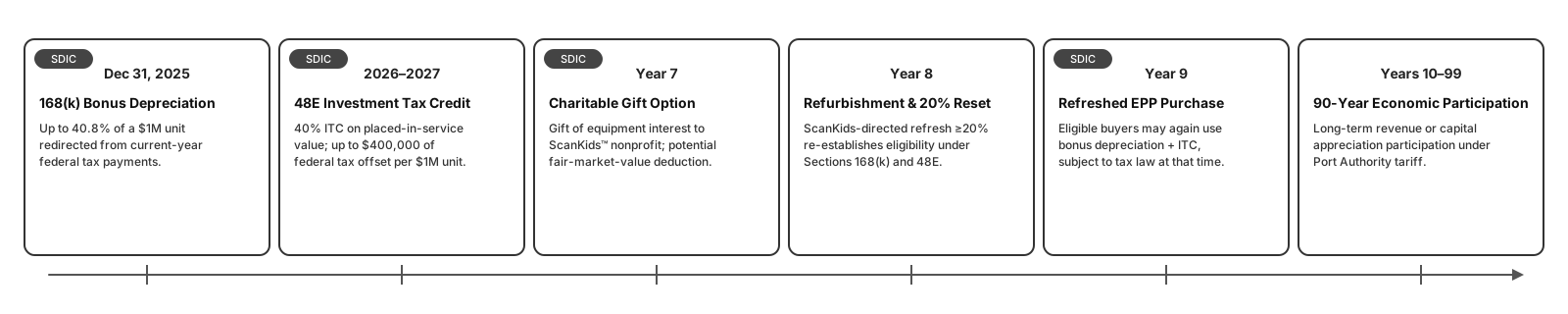
Four self-directed incentive capital (SDIC) events, one long-horizon refresh, and a 90-year participation window—mapped on a single arc.
This is how private capital, public purpose, and clean-energy infrastructure align to support children, families, and clinical innovation for generations.
ScanPortOKC campus is to be built around a central Thermal Utility Engine™ located beneath the Town Centre, supported by a network of geothermal wells and reinforced GreenPads that anchor each ScanPod™ and every future modular facility on the site. This Core distributes clean thermal energy, electrical and digital pathways, and water and wastewater services through underground modular tunnels (GreenBox™ Thermal) that connect to all pod-based structures across the 10+/- acre campus. These foundational elements allow the entire site — from the seven ScanPods to research modules, community spaces, lodging pods, and educational facilities — to operate on a unified clean-energy and geothermal system designed for long-term stability and expansion.
The Thermal Utility Engine™ is the centralized BTU reservoir for ScanPort. It stores heat and cold, sharpens temperature spreads, ties into geothermal wells, and helps each GreenBox™ produce more electricity by improving the thermal environment.
At small scale, it links 25 containers in a ScanPod™. At full scale, it is designed to coordinate 500+ micro-powerplants and micro-AI centers across the entire ScanPort campus.
The Engine is not designed to generate electricity itself—each GreenBox™ Beyond Mil-Spec™ does that—but it lets the entire system operate Beyond Net Zero. In full operation, the campus is designed to export surplus clean energy to surrounding communities, with the net revenue supporting ScanKids™ initiatives through the ScanPort 501(c)(4).
ScanPort OKC begins with a foundation.
A real one — pipes, wells, vaults, thermal systems, pads — but also a foundation of sequencing.
If the order is wrong, loss of time, increased costs, frustration. If the order is right, the entire campus becomes a self-powered research and community engine.
We begin with Phase One, which is the period where the site is created in its most essential form. This is where the Thermal Utility Engine™ is built, where the underground architecture takes shape, and where the first seven ScanPods — the anchors of the entire campus — take their places along the early perimeter. Before anything else can happen, the site has to be ready to receive it.
Phase One — Building the Spine of ScanPort™
Although the public will eventually see the cafés, the gardens, the research facilities, and the extraordinary architecture of the perimeter containers, the real work of Phase One happens long before any of that appears.
It begins with identifying the land, working with the governmental authorities to establish the framework, running the engineering models, preparing the site, and placing the earliest long-lead equipment orders so fabrication can begin.
The Thermal Utility Engine™ infrastructure is the first major milestone.
It is a massive, coordinated system — geothermal wells; large underground fluid tanks, deep thermal capture corridors; thermal distribution lines; high-pressure vaults; energy balancing pads; sensor-laden conduits; secure trenches; and the underground geometry that allows us to move heat as intentionally as other sites move air or water. Much of the equipment that runs this system must be fabricated months in advance. That is why the first step of this entire project is the acquisition and fabrication of the Thermal Utility Engine™ equipment.
While this work proceeds with engineers, underground preparation and fabrication teams, the public-sector infrastructure progresses in parallel. The newly formed governmental authorities move forward with tax-exempt municipal bonds to fund roads, shared utilities, site access, lighting, and the other elements of the public backbone. These elements are critical, but they cannot drive the schedule — not the way the Thermal Utility Engine™ does. The TUE is the pace car for the entire development.
As the TUE infrastructure is installed and the first container connetion Pads are located and set, the seven ScanPods begin fabrication. Their delivery and placement cannot occur until Phase One TUE systems are ready to receive and interconnect with these GreenBox™ Beyond Mil-Spec™ containers. Their arrival and activation mark the moment the site begins transitioning from development into operations. They are the first real Pod facilities on the ScanPort perimeter. They give the campus its first revenue-producing capability. These seven ScanPods are expected to establish roughly 40% of the perimeter wall. They tie directly into the TUE system that has been prepared to receive them.
Phase One is expected to run through 2026 and 2027, with the objective of placing as much infrastructure “in service” as possible during 2026 so that electrical and thermal systems can begin stabilizing, ScanPods can be installed, and the site can transition from a construction zone to a functioning organism.
Phase Two — Expansion Within a Living Framework
Phase Two begins when the campus has an operational heartbeat. The TUE is active, the seven ScanPods are installed, the perimeter wall is partially built, and the early public-sector systems are flowing. From this point forward, the site grows inward at the same time.
The perimeter continues to rise with additional GreenBox™ Beyond Mil-Spec containers — ultimately more than 500 of them — each of which carries its own micro-generation, thermal capture, storage, and distribution systems that plug directly into the architecture Phase One creates. They strengthen the TUE; they do not sit outside it. Every new container makes the whole campus stronger and its energy generation larger.
Inside the perimeter, new Pods take shape. These include research facilities, educational environments, child- and family-centered community spaces, scanning modules, therapy and recovery suites, as well as the village-life elements that make the entire development human: cafés, small restaurants, offices, storage, shops, lodging, quiet spaces, energy gardens, and places to meet, talk, rest, and work. This area is expected to include 100s of additional Pods made from more than 1000 GreenBox™ ISO containers.
If Phase One is about creating capability, Phase Two is about creating place.
It is the transition from infrastructure to community.
And because the underpinning of ScanPort is modular, adaptive, and energy-positive, Phase Two does not have a hard stop. It continues — as the site fills, as systems expand underground, as new research efforts join, and as future Pods are added. Every new Pod adds electrical generation and thermal modulation capacity. Every new Pod strengthens the thermal utility engine that supports the entire campus.
This is how ScanPort grows: by building on top of a foundation designed from the beginning to expand.
Each GreenPad™ | Geothermal Well Package includes one geothermal well and twenty-five reinforced GreenPads, all engineered using ISO intermodal container standards to support the modular ScanPod™ architecture and other pod-based facilities across the site. Each geothermal well is designed to provide stable, renewable thermal support, while twelve ISO-framed GreenPads distribute this energy across each GreenBox™ container footprint of a ScanPod™ and connect directly into underground container-based tunnel system that originates at Thermal Utility Core.
Each package is a part of the site’s Thermal Utillity Engine™, clean-energy equipment program, with participation secured by signing the standardized equipment purchase agreement and providing a 10% deposit. The eligible clean-energy systems within each package are engineered to qualify for significant federal clean-energy and digital-infrastructure incentives, with total offsets that may reach approximately 80% federal tax incentives.
This configuration gives every ScanPod™ — and every future pod-based facility in the campus — a consistent, repeatable foundation with long-term clean-energy support, temperature stabilization, and operational reliability. These packages may be acquired through this equipment facility and/or by individual purchasers.
ScanPort OKC is a large-scale undertaking — a campus built to last generations, a fusion of advanced digital intelligence, thermal-electric innovation, community health infrastructure, and container-based modular design. The full vision requires a carefully sequenced funding model, one that matches the architecture of the project itself: layered, resilient, and designed to expand as the campus grows.
To accomplish this, ScanPort relies on three coordinated funding pillars, each matched to a different part of the development sequence:
1. Private-Sector Funding for the Thermal Utility Engine™ (TUE) Infrastructure
The first pillar activates immediately. Before the land is fully prepared, before public-sector financing is completed, the TUE — the thermal and electrical backbone of ScanPort — must begin fabrication. This is long-lead, precision-built equipment, forming the underground and container-level architecture that allows the entire site to function.
To launch this core infrastructure, we begin with privately funded equipment interests. High-income participants have a unique opportunity to allocate federal tax incentives toward the capital formation needed to build the TUE. This early capital is not a supplement — it is the spark that allows Phase One to start. Without it, nothing at the site can be installed, powered, cooled, heated, or stabilized.
2. Public-Sector Infrastructure Funding (Tax-Exempt Municipal Bonds)
As the TUE begins fabrication and installation, the governmental authorities overseeing the site advance the public-sector infrastructure: roads, utilities, access, lighting, and the foundational components required for campus-wide operations. These elements are funded through tax-exempt municipal revenue bonds, supported by ScanPort tariff revenues. They are not funded with taxpayer dollars.
This second pillar does not drive the schedule — it runs in parallel with the private-sector catalyst that begins the project. But it is essential to delivering a fully functioning campus.
3. Private Funding for ScanPods and Modular Facilities
Once the TUE infrastructure is underway and the site begins taking shape, a separate private-sector program funds the ScanPods themselves and the specialized modular facilities that form the perimeter and interior structures. These include scanning systems, community pods, research and health pods, educational environments, and the dozens of specialized units that require custom fabrication.
This pillar runs on its own track, aligned with but distinct from the TUE. It ensures that the anchor tenants — the first seven ScanPods — and the supporting architecture can be ready for installation as soon as Phase One infrastructure is prepared to receive them.
⸻
A Funding Architecture Designed for Expansion
These three pillars create a development sequence in which:
• The TUE initiates the project and sets the pace
• Public-sector work follows in stride
• Modular facilities and ScanPods fill the campus as the backbone comes online
Together, they allow ScanPort to break ground early, accelerate the build cycle, and create a site with a long and expanding operational life.
As the campus moves from development into operations, additional funding cycles and equipment pools may be formed to support expansion, but the initial architecture remains constant:
early private capital creates the infrastructure,
public capital builds the backbone, and
modular capital brings the site to life.
How Participation Works
For individuals or businesses interested in subscribing for one or more equipment units, we encourage a conversation with your tax advisor. This opportunity is grounded in real equipment, to be placed in service on the ScanPortOKC campus, and qualifies under current federal incentives for bonus depreciation and the 48E Investment Tax Credit.
Subscribers choose to acquire their equipment interest through a single-member LLC or other passthrough entity.
This can:
• provide clean segregation of the equipment ownership,
• facilitate recordkeeping and risk management, and
• for some taxpayers, allow the activity to be treated as active participation (e.g., the 100-hour rule) so that bonus depreciation may offset W-2 or business income.
Each subscriber’s situation is different, so your own CPA or tax counsel should confirm how the incentives apply in your case.
We do not provide tax, legal, or accounting advice. Subscribers should rely solely on their professional advisors to determine suitability.
The General Procedure
The process for securing an equipment unit is simple:
1. Confirm with your CPA how 2025 bonus depreciation and the 2026 48E ITC apply to your situation.
2. Identify or form the entity you wish to use for ownership (LLC passthrough is common).
3. Select the number of $1,000,000 equipment units you wish to subscribe for.
4. Execute the applicable Equipment Purchase Agreement.
4. Make the initial 10% payment before December 29, 2025 to secure the federal 2025 bonus depreciation position.
5. Follow scheduled progress payments as equipment is procured and installed as part of the Thermal Utility Engine™ and ScanPort energy system.
Throughout the operating period, subscribers receive the standard annual cost-reimbursement related to insurance, monitoring, and required servicing of the equipment.
A Purpose-Driven Transition After Five Years
After federal recapture periods have passed, subscribers may choose to gift their equipment interest to the ScanPort 501(c)(4), ScanKids™.
Depending on individual tax circumstances, this charitable gift may produce an additional incentive offset, while directly supporting the ScanKids™ mission for children, youth, and Long COVID research.
This action completes the subscriber’s participation in a way that both secures the tax benefits they earned and helps sustain the community programs ScanPort™ was built to support. Alternative, involves a sale to the Sponsor at Fair Market Value at the time. Subscribers may find this a less attractive alternative as it may result in recovery of bonus depreciation as ordinary income.
Tax Overview for Professional Advisors
(Reference summary for the subscriber’s CPA or tax counsel)
The Thermal Utility Engine™ program involves the acquisition of tangible equipment that forms part of the ScanPortOKC clean-energy system.
The equipment is engineered and scheduled as Qualified Energy Property to be placed into and operated as part of a §48E Qualified Facility.
1. Bonus Depreciation (2025)
Subscribers who complete the initial 10% payment before December 29, 2025 may be eligible to deduct 100% of the equipment cost for the 2025 tax year under current bonus depreciation rules (§168(k)).
Bonus depreciation applies without basis reduction for §48E.
2. §48E Clean Electricity Investment Tax Credit (ITC)
Qualified Facility – Statutory Definition
Under §48E(c)(3)(A), a Qualified Facility is a facility:
used for the generation of electricity,
placed in service after December 31, 2024, and
with an anticipated lifecycle greenhouse gas emissions rate not greater than zero.
Application to the Project
In the ScanPort project, electricity generation occurs at the distributed GreenBox™ container units, each with a nameplate capacity of less than 1 megawatt. These units meet the classification requirements for small facilities under §48E.
Qualified Energy Property
The equipment subscribed for within the Thermal Utility Engine™ complex is classified as Qualified Energy Property under §48E(d), including:
thermal energy storage systems exceeding 5 kWh capacity,
temperature-differential and thermal-transfer equipment,
GreenBox™ Thermal tunnel piping and thermal storage system,
geothermal interface systems,
thermal reservoirs and buffering equipment, and
integral property placed in service as part of the Qualified Facility.
Domestic Content
The project’s procurement plan anticipates satisfying the domestic content requirement (≥45% U.S. components) for the prevailing §48E ITC rate, currently estimated at 40%, subject to final IRS guidance.
3. Entity Structure and Active Participation
Subscribers may acquire their equipment interest through a single-member LLC or other passthrough entity, which can:
segregate the equipment activity,
streamline recordkeeping, and
for some taxpayers, support treatment of the activity as active participation (e.g., satisfying the 100-hour rule).
Subscribers should rely on their own CPA or tax counsel to determine whether:
bonus depreciation may offset W-2 or other active income,
§48E applies to their circumstances,
the equipment should be held directly or through an entity,
and whether additional state-level considerations apply.
Important Note
We do not provide tax, legal, or accounting advice.
Subscribers must rely exclusively on their own licensed advisors to determine:
eligibility for federal incentives,
characterization of activity as active or passive,
appropriate entity structure,
and treatment of any charitable gifting after the federal recapture period.